Hot Tub Crime Machine

Solving mysteries at 104 degrees Fahrenheit (40 degrees Celsius).

  • Home
  • About
Posts Comments
  • advertising
  • social media
  • brands
  • random stuff
  • Account Planning
  • Trends
  • Technology
  • Uncategorized
  • videos
  • Gadgets

How to Become A Planner — Part VI

June 10, 2014 4 Comments

My posts on how to become a planner are pretty much the only things on this blog that get any traffic. Maybe it’s because this field is so damn hard to get into. Maybe because I am an awesome writer. Maybe because the internet is just a bunch of spam bots. Who knows?

What I do know is that a year ago, BBH lost an amazing planner, mentor, and overall an amazing human being (from what I’ve read). His name was Griffin Farley. And to keep his legacy alive, they created the Griffin Farley Search for Beautiful Minds program. Its “a weekend boot-camp open to individuals looking to get their break into strategy and a platform for them to showcase their thinking to the industry while taking a step toward finding a job.” Read more of this post

Share this:

  • Click to share on Reddit (Opens in new window) Reddit
  • Click to share on X (Opens in new window) X
  • Click to share on Tumblr (Opens in new window) Tumblr
  • Click to share on LinkedIn (Opens in new window) LinkedIn
  • Click to share on Facebook (Opens in new window) Facebook
  • Click to email a link to a friend (Opens in new window) Email
Like Loading...

Filed under Account Planning Tagged with Account Planning, advertising, BBH, Griffin Farley, Marketing and Advertising, planning, search for beautiful minds, Strategy

Your Customers are Stupid.

October 21, 2013 Leave a comment

Here’s the presentation that Tim Parcell and I gave at Big D 2013, October 19th, 2013 in Addison, Texas.

In it we discuss various cognitive biases that affect how your customers act, along with ways to design around those biases.

Most of the content was voiced over, so just reviewing the slides may not be awesome. But if/when I get the video/audio of the presentation, I’ll post that too.

Share this:

  • Click to share on Reddit (Opens in new window) Reddit
  • Click to share on X (Opens in new window) X
  • Click to share on Tumblr (Opens in new window) Tumblr
  • Click to share on LinkedIn (Opens in new window) LinkedIn
  • Click to share on Facebook (Opens in new window) Facebook
  • Click to email a link to a friend (Opens in new window) Email
Like Loading...

Filed under Account Planning, Conferences Tagged with @freescribbles, Account Planning, Big Design, Big Design Conference, Cognitive bias, conferences, Decision making, Marketing and Advertising, Presentations, Strategy

The Automotive Arms Race

October 9, 2012 Leave a comment

Two weeks ago, after attending an all day “immersion session” about a new vehicle my clients in Detroit are launching I was getting into my car in the satellite parking lot when a car pulled up next to me.

“Hey” said the driver, “You guys just coming from [CLIENT NAME REDACTED]? You work there? Agency guys?”

He was driving a vehicle made by my client, was in a parking lot that I believe is affiliated with my client, but this seemed a little off.

“Yeah, agency,” I replied, feeling uneasy. Who was this guy? “We were at a workshop.”

“So what’d they have up there? New vehicles?”

This is when I started getting nervous. I gave my co-worker the “get the F^&K in the car, now,” look and curtly replied “Just learning about some vehicles.” and got in the car as he drove off.

I have no idea who he was. My memory is fuzzy, but he may have looked like this:

Spies

Read more of this post

Share this:

  • Click to share on Reddit (Opens in new window) Reddit
  • Click to share on X (Opens in new window) X
  • Click to share on Tumblr (Opens in new window) Tumblr
  • Click to share on LinkedIn (Opens in new window) LinkedIn
  • Click to share on Facebook (Opens in new window) Facebook
  • Click to email a link to a friend (Opens in new window) Email
Like Loading...

Filed under advertising, brands Tagged with Account Planning, advertising, Arms race, Automobile, Automotive industry, brands, Cold War, Detroit, Marketing and Advertising, planning, Strategy

Kicking off

September 18, 2012 Leave a comment

As a planner, I am often most involved at the beginning of a new project. The part when clients are coming to their agency with a problem they need help solving. This usually comes in the form of a “client brief” or a “marketing brief” (not to be confused with the creative brief).

And this client/marketing brief is the key to getting good creative, and ultimately solving the client’s problem in an awesome way.  Read more of this post

Share this:

  • Click to share on Reddit (Opens in new window) Reddit
  • Click to share on X (Opens in new window) X
  • Click to share on Tumblr (Opens in new window) Tumblr
  • Click to share on LinkedIn (Opens in new window) LinkedIn
  • Click to share on Facebook (Opens in new window) Facebook
  • Click to email a link to a friend (Opens in new window) Email
Like Loading...

Filed under Account Planning, advertising Tagged with Account Planning, advertising, Client, creative briefs, Marketing and Advertising, planning, Strategy

Screw your agenda

September 17, 2012 Leave a comment

I write a lot of presentations. Almost entirely using PowerPoint.  A big part of being a planner is being able to tell a story. The story of the brand, the story of consumer, the story of the strategy we need to create against, the story of the strategy and why the work you are about to see is the best way to address the consumer problem/challenge.

I usually start out by talking about the problem that we are trying to solve. I make sure that we’re all on the same page regarding what we are supposed to be working against.  Read more of this post

Share this:

  • Click to share on Reddit (Opens in new window) Reddit
  • Click to share on X (Opens in new window) X
  • Click to share on Tumblr (Opens in new window) Tumblr
  • Click to share on LinkedIn (Opens in new window) LinkedIn
  • Click to share on Facebook (Opens in new window) Facebook
  • Click to email a link to a friend (Opens in new window) Email
Like Loading...

Filed under Account Planning, advertising, Presentations Tagged with Account Planning, advertising, Clients, planning, PowerPoint, presentation, Presentations, Strategy

We’re all storytellers.

June 11, 2012 4 Comments

By “we’re all” I mean advertising people, who I assume make up the majority of this blog’s readership (the remainder of you came here searching for “Kim Kardashian Hot Tube” whatever the hell that is – the link is workplace safe, don’t worry).

And by storytellers, I mean that we all need to create interesting narratives in order to our job. I don’t care if you’re an account guy or girl, a copywriter, a planner, a experience designer, or a art director. If you can’t tell the story, you won’t be successful. Account people need to sell in work, ideas, strategies and budgets to the clients. Copywriters and art directors need to tell a story to the consumer that resonates with them and makes them care. Strategists & planners need to tell a story about the consumer in a way that intrigues the client and sets up the creative as the ideal solution to their problem.

Read more of this post

Share this:

  • Click to share on Reddit (Opens in new window) Reddit
  • Click to share on X (Opens in new window) X
  • Click to share on Tumblr (Opens in new window) Tumblr
  • Click to share on LinkedIn (Opens in new window) LinkedIn
  • Click to share on Facebook (Opens in new window) Facebook
  • Click to email a link to a friend (Opens in new window) Email
Like Loading...

Filed under Account Planning, advertising, brands Tagged with Account Planning, advertising, brands, planning, Storytelling, Strategy

The Intersection of Strategy and Design

June 5, 2012 Leave a comment

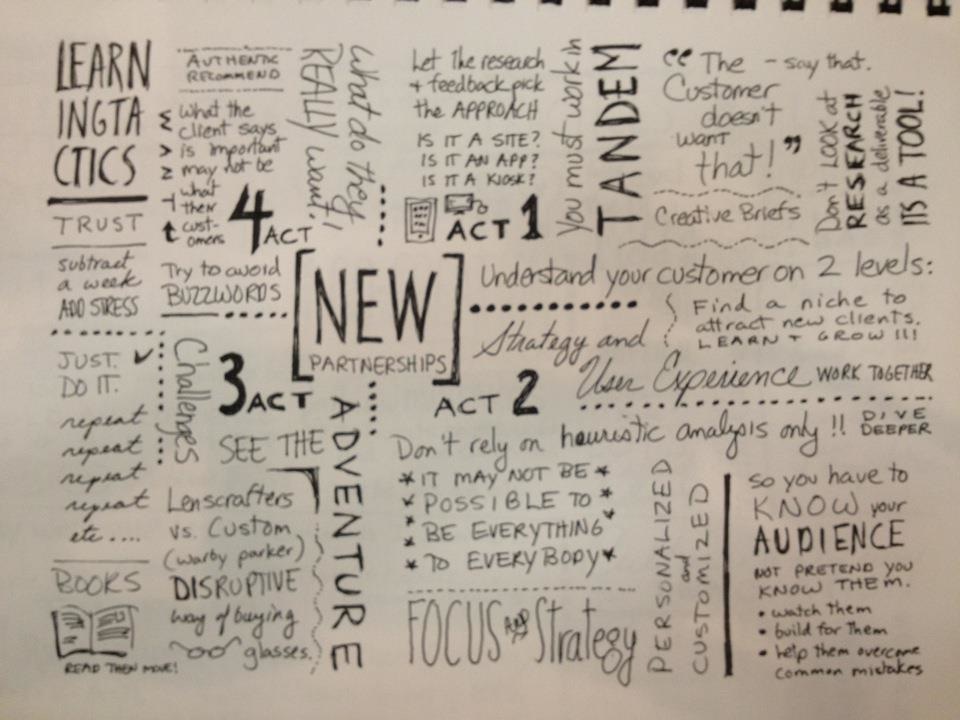
I recently had the privilege of presenting at the Big Design Conference in Addison, Texas with my colleague Tim Parcell. Since it was a design/UX focused event we decided to present on the way that we partner together to make the work better. We showed our different POVs on user wants/needs – mine, as a planner/strategist, tends to focus more on emotional needs, attitudes, and feelings. Tim, as an experience designer, tends to concentrate more on rational and functional needs and tasks to be completed.

We talked about the need to build better experiences for our customers and the crowded marketplace full of distractions and commodity products that makes the job of the advertiser considerably more difficult than it was in Don Draper‘s day.

And we talked about ways that designers can bring a strategic point of view to their work, whether it’s at an agency, or in-house on the client side.

Here’s the presentation we gave, I hope you enjoy it:

And for those of you who don’t like slide decks, one of the attendees live-sketched the presentation and shared her sketch with us:

Big Design Conference New Partnerships

Share this:

  • Click to share on Reddit (Opens in new window) Reddit
  • Click to share on X (Opens in new window) X
  • Click to share on Tumblr (Opens in new window) Tumblr
  • Click to share on LinkedIn (Opens in new window) LinkedIn
  • Click to share on Facebook (Opens in new window) Facebook
  • Click to email a link to a friend (Opens in new window) Email
Like Loading...

Filed under Account Planning, advertising, Conferences, Presentations Tagged with Account Planning, advertising, Big Design, Big Design Conference, conferences, Free Scribbles, planning, Strategy, Tim Parcell

How to become a planner – Part V

May 23, 2012 5 Comments

I love reading about how people got into account planning. Mainly because it seems like so many of us have such interesting, unique, and different backgrounds. Although there are schools and programs designed to train you to be a planner, it seems like most people start out doing something (academia, journalism, production, account management, etc) and later decide to move into account planning.

But I also like reading about it because I find that I get asked “How can I do what you do?” A LOT. And I don’t always have a good answer. My career path was strange and probably very difficult to replicate (and you’d have to be crazy to want to). So I have trouble telling people how THEY can become planners.

My latest find in this category comes from the blog Junior, who was lucky enough to get some time with Mark Pollard to talk about his career.

His key points are:

  1. It’s hard to break into the field.
  2. You need to make yourself desired and/or interesting to the planning director (great dating analogy).
  3. You need to make your desires known.

You can read the entire article here.

If you’re interested in reading more about how to become a planner, check out these other posts:

  • How to become a planner
  • Part II
  • Part III
  • Part IV

Share this:

  • Click to share on Reddit (Opens in new window) Reddit
  • Click to share on X (Opens in new window) X
  • Click to share on Tumblr (Opens in new window) Tumblr
  • Click to share on LinkedIn (Opens in new window) LinkedIn
  • Click to share on Facebook (Opens in new window) Facebook
  • Click to email a link to a friend (Opens in new window) Email
Like Loading...

Filed under Account Planning, advertising, Blogging Tagged with Account Planning, advertising, blogs, brands, Careers, Mark Pollard, planning, Strategy

If You’re Reading This, You Are Not Your Target Market

May 21, 2012 1 Comment

A lot of my friends and colleagues have been passing around this infographic lately:

Ad people social

As the chart clearly shows, we’re a social group. I’ve seen (and posted myself) this chart on blogs, Facebook, Twitter, Tumblr, and others. It shouldn’t surprise me. It shouldn’t surprise any of us. We’re in the business of communications, we’re constantly searching for some new, different, way to communicate. When you factor in that our clients demand that we have a POV on every new Instagram clone, or digital pinboard, of course we’re going to be heavy users of social media.

But we also need to remember who we are talking TO.

This past Saturday, I spent part of the afternoon wandering through Boston’s Earth Fest on the esplanade and was harshly reminded of who the mass audiences are. I guarantee the people I saw there have been the target of at least a few of my clients over the years. And this isn’t me being a snob, or passing judgement on anyone (except maybe people in the advertising world), but the truth is (and backed up by the chart above) that most people are not nearly as tech savvy as advertisers would like to believe they are.

What I saw was people outside, listening to music, sampling eco-friendly food and products, hanging out with their friends, enjoying the nice weather.

What I didn’t see was people with their hands and faces glued to mobile devices. I didn’t see anyone carrying around an iPad. The only tablets I saw were being used by the vendors to collect names/emails, or process contest entries. I saw a Samsung Galaxy Note tent, but didn’t see a lot of people lined up to play with a new tablet. Not nearly as many as I saw lined up for a taste of sweet potato tater tots.

Facebook may have 900 million users, Instagram may be worth one billion dollars, but when it gets down to real people, living their daily lives, they aren’t checking in constantly. They aren’t posting everything the moment it happens. They aren’t showing the world every single piece of food they consume.

One of my favorite bloggers/planners, Martin Wiegel, once posted a series of “bold statements” (as I called them) including one that said “It’s still mostly a 1.0 world.” Looking around the masses who attended Earth Fest with me yesterday, I couldn’t help but agree. These are the mass consumer, yet they are not constantly looking for the next big thing. They aren’t seeking to find the coolest things ever and share them with their friends before anyone else does. That’s a very small subset of the much larger audience.

I recently took part in a two-day workshop with clients from a regional bank in New England. They position themselves as being all about service, about going above and beyond in the name of the customer. After two days of constantly referencing Zappos, the COO turned to me and said “What does Zappos sell?”

You’d think we had been talking about Fab.com or some obscure niche site, not the largest online footwear retailer ever. Not the darling of every business school, business magazine, and online shopper. Not a company that had been acquired for almost one billion dollars just a few years before. And yet, he had never heard of it.

Since Cracked, Mashable, and BuzzFeed have proven beyond a reasonable doubt that everyone loves to consume read lists (only marketing targets “consume” media, real people read/watch/listen/play with stuff), I’ll use that format for my recommendations:

  1. Spend time people. As any planner worth his salt will tell you, you need to get out and be around people. You will never learn anything truly unique or powerful by only reading trend reports or looking at what people say on Twitter (note the use of “only” – I’m not saying reports, research, and social media aren’t useful).
  2. Keep it simple. The KISS rule has been around for ages and the more advanced our means of communication get the more relevant the message gets.
  3. Remember the Pareto Principle. Often called the “80-20” rule, this means that for any behavior, whether it’s sales, content creation/consumption, etc 80% of it comes from 20% of the people. Most of your consumers are not going to make a video telling the world why they love your product. No matter what the prize is.
  4. Be aware of mass media. I’m not saying you need to watch Real Housewives of Whatever, or American Idol. But you better know what it is. Because most of your consumers do. And most of them care a hell of a lot more about it than a really interesting SlideShare presentation you saw, or the latest TED talk. I hate reality TV, but if you want to talk to consumers you need to be able to tall about the things that matter to them.
  5. Avoid snobbery. I’m one of the last people who should talk about this, I tend to look down on the “unwashed masses” with my most critical eye, but you really need to avoid it. They may not appreciate the “finer things” that you think you do, but these are the masses. They are the reason we all have jobs. They might prefer watching a baseball game to spending an afternoon at a museum, or watching Real Housewives instead of Downton Abbey, but they pay your salary.

Share this:

  • Click to share on Reddit (Opens in new window) Reddit
  • Click to share on X (Opens in new window) X
  • Click to share on Tumblr (Opens in new window) Tumblr
  • Click to share on LinkedIn (Opens in new window) LinkedIn
  • Click to share on Facebook (Opens in new window) Facebook
  • Click to email a link to a friend (Opens in new window) Email
Like Loading...

Filed under Account Planning, advertising, brands, Trends Tagged with Account Planning, advertising, brands, planning, Strategy, trends

Talk to your customers, but don’t ask them what they want.

April 25, 2012 Leave a comment

I’m not really a huge Henry Ford fan. While you have to respect his business acumen and innovation, it’s really hard to see past his anti-semitism and support of Nazi Germany prior to the US entering WWII.

But one thing he did that I do like, is provide the world with this quote:

“If I had asked people what they wanted, they would have said faster horses.”

And then decades later, Steve Jobs came along and echoed a similar sentiment:

“A lot of times, people don’t know what they want until you show it to them.”

Often times, we are too reliant on asking people what they want. Or what they think they want. Or whether they would like some abstract idea. Notice that Steve Jobs didn’t say “A lot of times, people don’t know what they want until you show them a concept board.”

The problem is context. Even if you have a great idea, without the proper context consumers cannot imagine how a new idea/product/service fits into their lives.

One example of this from my life is tablet computers. In 2005, when I was in grad school, our IT strategy professor gave us a lecture about tablet computing. He demonstrated tablets by running his whole class on something like this:

Toshiba Tablet

That was a state of the art tablet at the time. It was essentially a laptop where you could swivel the screen around and fold it over the keyboard then write on the screen with a stylus. It was a terrible experience. It was heavy, not terribly fast and really, offered nothing that regular laptops didn’t (other than writing on the screen – and who really needed that?).

And then came this:

iPad

And it blew every other tablet out of the water. It revitalized the whole concept of tablets. And I’m sure that Steve Jobs didn’t ask customers if they wanted tablets. He looked at how people use technology and made a device that enhanced their experience. If he had asked people whether they wanted a tablet or what they thought of tablets, they would have imagined that Toshiba above and said “no thanks.”

But my absolute favorite example of this is text messaging. In 2001 I participated in a focus group about text messaging. Because as strange as it seems now, back in 2001, in the US, not many people were using text messaging. Back then, I was using one of these:

LG 5250

It pretty much just made calls and stored phone numbers. So when I was told that I would be able to use a phone to send text messages to people I thought it was a terrible idea. I couldn’t imagine typing on a number pad to send one-way messages. I couldn’t imagine when I would WANT to use text messages. I conceded that if I was in class, or in a loud bar, it might be more convenient than making a phone call, but I couldn’t grasp the idea of sending someone a message and not getting an instantaneous response like you do when you are actually talking to them.

And now? Last month I sent 393 text messages. Thats 13 a day. How much did I talk on the phone? 135 minutes. 4 minutes a day. I hate talking on the phone and pretty much only talk on the phone with my parents and customer service reps.

21 year old me thought that talking on the phone was more convenient than texting and waiting for a reply. But now, most people would agree that calling, waiting for the other person to answer, making pleasantries, and then finally getting to the reason for the call is much more inconvenient.

So stop asking your customers what they want. And definitely stop asking your clients what they think their customers want. Get out there and meet your customers. Spend time with them. Observe them. Talk to them about how they solve problems in their life. And then take what you learn and figure out how to solve those problems better.

But unless you make faster horses, don’t ask them what they want.

Share this:

  • Click to share on Reddit (Opens in new window) Reddit
  • Click to share on X (Opens in new window) X
  • Click to share on Tumblr (Opens in new window) Tumblr
  • Click to share on LinkedIn (Opens in new window) LinkedIn
  • Click to share on Facebook (Opens in new window) Facebook
  • Click to email a link to a friend (Opens in new window) Email
Like Loading...

Filed under Account Planning, advertising, brands, Technology, Trends Tagged with Account Planning, advertising, brands, Henry Ford, IPad, planning, SMS, Steve Jobs, Strategy, technology, trends

← Older posts

Newer posts →

Me

Unknown's avatar

I'm me?

Follow me on Twitter

Tweets by ezra802

What do I write about?

Aaron Dignan Account Planning advertising Advertising and Marketing advertising careers AirBnB Andrew Hovell Apple apps art Big Design Conference blogs brands Business Careers CES conferences Consumer Electronics Show creative culture customer service ecommerce facebook fail foursquare funny gadgets Gambling games Gareth Kay humor IPad iphone Joe Gebbia journalism kickstarter LinkedIn location-based Lost Marketing and Advertising McDonald's Microsoft Tag mobile-social MOD Live Monopoly NFC Northern Planner path planning presentation Pricing Prisoner's Dilemma privacy psfk Robert Heinlein roomba Scott Karambis SCVNGR Seth Priebatsch simpsons social media Social network Stealth Steve Jobs Strategy techcrunch technology TED trends TV Twitter video Viral Water weber shandwick

Create a free website or blog at WordPress.com.

Hot Tub Crime Machine
Create a free website or blog at WordPress.com.
Privacy & Cookies: This site uses cookies. By continuing to use this website, you agree to their use.
To find out more, including how to control cookies, see here: Cookie Policy
  • Subscribe Subscribed
    • Hot Tub Crime Machine
    • Join 97 other subscribers
    • Already have a WordPress.com account? Log in now.
    • Hot Tub Crime Machine
    • Subscribe Subscribed
    • Sign up
    • Log in
    • Report this content
    • View site in Reader
    • Manage subscriptions
    • Collapse this bar
 

Loading Comments...
 

    %d